
(If you just want a quick link to the pattern for purchase and don’t want to read this whole post just go to this link: http://www.ravelry.com/patterns/sources/national-park-centennial-celebration-blanket)
The subtitle to this post could be “why I have not blogged almost at all this past year.” A little bit more on that later but first…
The first few rows of a knitted blanket designed and created to celebrate the centennial of the National Parks.
I have been meaning to write this post for weeks now, but decided that this week – National Parks Week – was most appropriate. April 16th – 24th is National Parks Week for 2016 – this means that entrance fees into the parks are waived and national parks units across the country are holding special events. It also means that Twitter created an adorable little park ranger emoji as part of the #findyourpark campaign.
National Park Centennial
The 2016 National Park Week is especially historic since this year is the 100th anniversary of the National Park Service. About a year ago, I was sitting at a conference – way in the back of the room – listening to a presentation by the National Park Service about their outreach and media campaign for the upcoming centennial. Like any good knitter, I had an easy and mindless knitting project in my bag so that I could knit while listening and learning. During the talk on the National Park Service (NPS) Centennial, the presenter mentioned – in passing – that many art projects were being inspired by the NPS Centennial and that “quilters are a group that gets all over things like this.” After hearing that statement, a little light bulb went off in my head and I thought “well if quilters can really get into this idea of parks and quilting, knitters can too!”
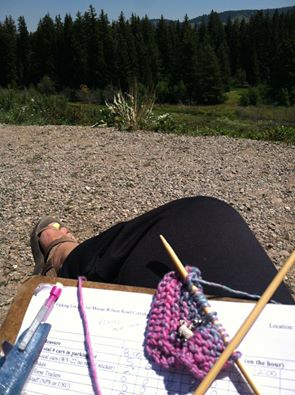
Not only do I bring knitting with me to conferences, but also to national parks where I do my field work.
Knitting meets National Parks: National Park Centennial Celebration Blanket
After the conference, on my plane ride back home, I planned a knitting project to celebrate the national parks and the centennial of the National Park Service. The project would be a quilt-style blanket made up of a knitted square for each national park and one square to represent the National Park Service. Some quick math made me realize that having a square for each park and one for the NPS was going to be 60 knitted squares. And if I wanted there to be any resolution and flexibility in the design of the squares they would need to be relatively large (6″ by 6″).
There was no way I could accomplish this project on my own (while also trying to succeed in academia and having something resembling a life). So I quickly contacted the lovely members of my knitting group out of Logan, Utah – Smart Knits – and ran the project idea by some of the more seasoned knitters in the group. The response was more enthusiastic than I could have ever dreamed! Nine other knitters volunteered their time, creativity, needles, and sometimes frustration to the project. Some members of the knitting group even moved away during the project and continued to work from a distance; mailing me their finished blanket squares.
We split up all 59 national parks, secured a generous yarn donation from Knit Picks, and began designing. Nine months later, I had a stack of blanket squares piled in my office, ready to be blocked, photographed, and released on Ravelry (a clearing house for knitting patterns). And I could not have been more pleased with the finished squares! The ingenuity, creativity, and crafting skills of my knitting group blew me away! We decided to name our project the National Park Centennial Celebration Blanket.
Patterns:
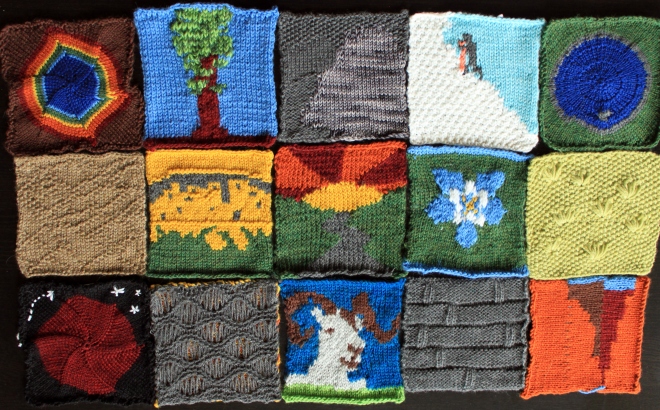
Each National Park is represented in the blanket by a 6″x 6″ square. Some of the blanket squares are colorwork designs while others are abstract representations of the park or a resource protected by the park. Each blanket square pattern comes with an introduction to the national park it represents and explains the inspiration for the square. The National Park Service is also represented through one of the square designs (only available to those who buy a blanket subscription) – making a total of 60 squares. These 60 squares can be arranged into a blanket that is 6 squares by 10 squares or 5 squares by 12 squares.
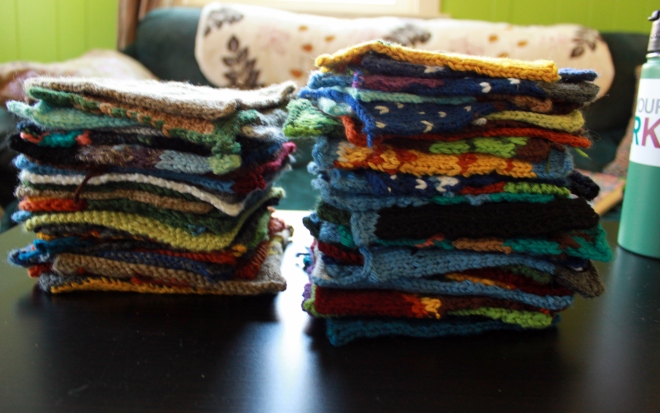
Stack of all of the completed National Park Centennial Celebration Blanket.
Subscription:
There are two options for purchasing the blanket square patterns. For $20, knitters can purchase a subscription to the National Park Centennial Celebration Blanket eBook. Subscribers will receive 5 blanket square patterns per month from January 2016 through December 2016. The blanket squares will be released in the order in which the national parks were designated by the U.S. government. With the subscription, knitters can slowly work on the blanket during the entire year of the NPS Centennial and end the year with a completed blanket. Subscribers will also receive a special blanket square that represents the National Park Service on August 25th, 2016 (the 100th anniversary of the Organic Act of the National Park Service being signed into law).
For those individuals not wanting to buy a subscription to the blanket, each individual blanket square pattern will also be released on Raverly for $1. These squares can be purchased and used to knit drink coasters, pieced together to make a scarf of your favorite national parks, or knit together in a smaller baby blanket or place mat.
Yarn:
We realized that this project could take up a ton of yarn and given that our knitting group is made up of mostly poor graduate students, we knew we could not afford to all buy yarn for this project. So we prioritized the colors that we wanted to include in the blanket (mostly earth tones), decided to knit the blanket in DK weight yarn, and contacted Knit Picks about a yarn donation. Knit Picks kindly donated more than enough yarn to complete the project. Thanks Knit Picks!
To knit the blanket you will need two skeins of each of these colors of Knit Picks Swish DK: Coal, White, Marble Heather, Twilight, Dusk, Forest Heather, Allspice, Garnet Heather, Honey, and Bark. We tried to use only these 10 colorways in our designs but you will see other accent colors occasionally used. You have a few options here, you may substitute for similar colorways that have already been purchased from Knit Picks. Alternatively, you may use scrap yarn from your stash that is a DK weight as accent colors for some of the squares. You could also buy a few additional skeins of accent colors from Knit Picks (you will likely just need one skein of each). Some accent colorways that we used of Knit Picks Swish DK include Conch, Doe, Marine Heather, and Wonderland Heather.
Depending on the size of your yarn stash, this blanket could also be done completely as a stash busting project! Each square takes, on average, about 25 to 30 yards of DK weight yarn. The blanket can also be knit in heavier or lighter weight yarn depending on what you have in your stash.
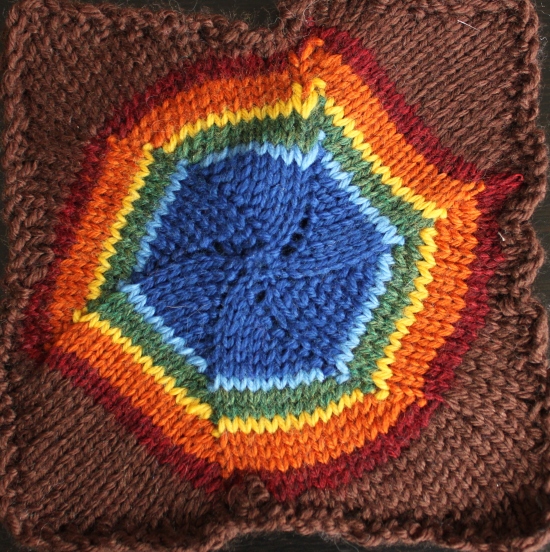
Yellowstone National Park was our nation’s first national park (Thanks Teddy Roosevelt!). Yellowstone is represented here in a knitted blanket square with a depiction of Grand Prismatic Spring.
Backing:
Since we realize that the back of the blanket will be a bit of a mess with floats from Intarsia colorwork, weird stretching from cables, and weaved in ends – we will be designing a national parks-themed fabric backing for the blanket to be posted on Spoonflower this summer. So individuals who knit the blanket will have an option to buy the fabric from Spoonflower. We are going to provide instructions to the blanket subscribers for adding a fabric backing. Lucky for Smart Knits, one of our members is a sewing instructor at Utah State University!
Border:
Subscribers will also receive instructions for knitting a border that can then be sewn around the edge of the finished National Park Service Centennial Blanket. This border will also provide an easier way to attach a fabric backing to the completed blanket. The border can be knit with leftover yarn from the project, stash yarn, or through purchasing extra skeins of the Knit Picks Swish DK colorway that you would like to use for your border. Our example will be knit with Knit Picks Swish DK in Bark. The border is completely optional.
Customization Ideas:
A few additional ideas for ways to customize the National Park Service Centennial Blanket:
- Some individuals are crocheting borders around each square to make a buffer when seaming the squares together into the blanket.
- An alternative to the fabric blanket is knitting a backing for each individual square or double knitting the squares.
- Share the project with a friend! One member of Smart Knits is sharing the pattern with her mother-in-law and they are each knitting half of the blanket squares to be combined into a single, finished blanket.
What other ideas do you have to make this project your own?
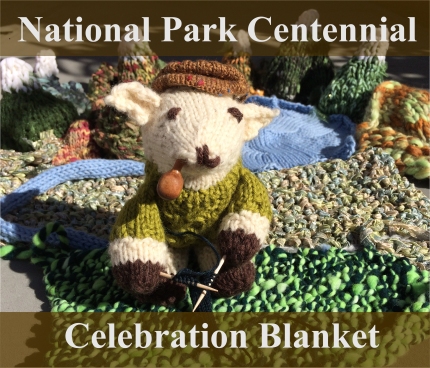
Sir Lambsalot – our Smart Knits mascot – hanging out and knitting in his own knitted “national park” complete with mountains, streams, and lovely vegetation.
Donation:
This blanket project is not just a way to celebrate the national parks and the National Park Service, but it is also a way to support the national parks. All proceeds from the sales of the National Park Centennial Celebration Blanket (both subscriptions and the sales of individual squares) is being donated to The National Park Foundation.
Thank You:
So many thank yous to my amazing knitting group, Smart Knits, for their passion for the project and their love of national parks! Natalie, Adrian, Leah, Kelly, Ryan, Liz, Reina, Beth, and Jennifer – you guys rock so hard.
Thanks to Cindy from Ravelry for her enthusiasm for the project and for volunteering her time (even though she has never met any of us!) to editing the patterns before I send them out to subscribers! You are amazing and a testament to why I love the knitting community.
Thank you to Knit Picks for their yarn donation to start this project! Without their help and kind donation this project would not have been possible.
Happy knitting!
The past year, blogging has taken a back seat to organizing this project. I blog as a form of education and outreach for public lands and outdoor recreation. During 2015 and likely most of 2016, the time I would have spent writing posts will likely be spent writing up, editing, and releasing patterns for the National Park Centennial Celebration Blanket. So, expect to see fewer blog posts this year, but hopefully I can continue to find time to explore our nation’s national parks during the centennial year!
And you to should go find your park! Google created a handy little map to help you out.
I cannot wait to see all of these amazing projects on Ravelry! Also, if you post on Instagram feel free to use the hashtag #npsblanket and #findyourpark (the official hashtag for the NPS Centennial). Happy knitting!
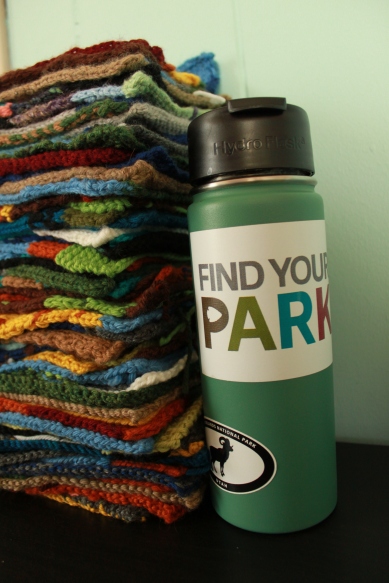
Of course I have a #findyourpark bumper sticker on my water bottle…

 The Average Visitor